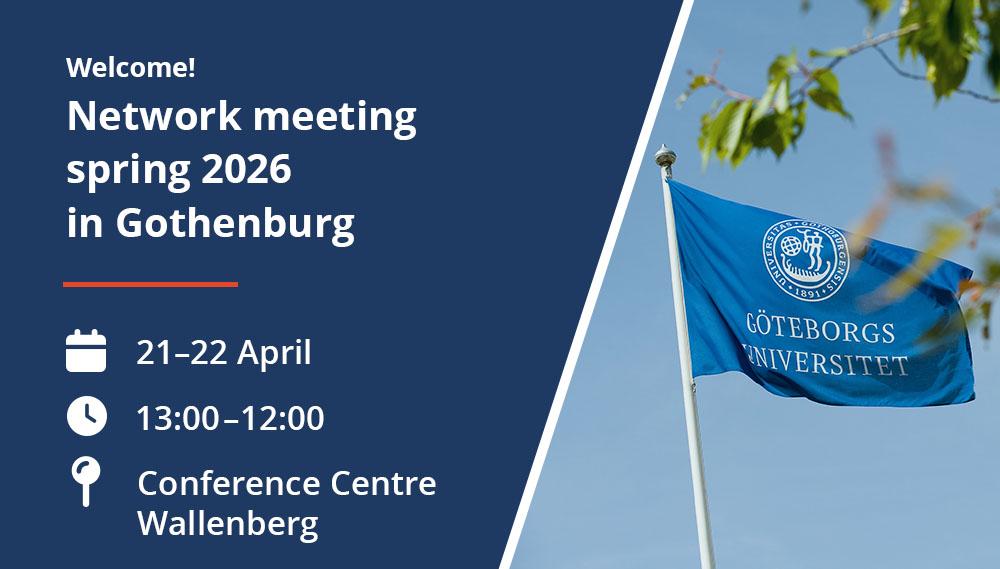
Welcome to Gothenburg for the SND Network’s spring meeting!
This year’s first in-person SND Network meeting will be hosted at the University of Gothenburg and has two main themes: The future of the SND Network and (open) access to geodata.
Day 1: The future of the SND Network
Last year, a proposal was presented suggesting that the Swedish Research Council be given national responsibility for coordinating Swedish research e-infrastructure. One part of the proposal is that SND’s activities would be incorporated into the Swedish Research Council. The proposal emphasises the value of the SND Network as an important national knowledge hub in research data management and access to research data, and stresses that the network should remain in place. A clarifying government mandate is expected in spring 2026.
The first day of the meeting will focus on the future and on what this proposal could mean in practice. What might the SND Network look like if SND becomes part of the Swedish Research Council, and how could the network operate in that new context?
The discussions will centre on the following questions:
- The SND Network provides opportunities for collaboration between network members as well as for national coordination. Which aspects of the support provided through the SND Network work well? What additional support do you need that cannot be provided within your own organization?
- What points of contact are needed within higher education institutions in order to capture researchers’ needs? What support do you need from SND in this work?
- What incentives are needed to achieve the kind of contribution currently provided by Domain Specialists and the Flagship projects? Feel free to give concrete examples of other models that could work, beyond the Domain Specialists and Flagships.
For further reading, here is a link to the proposal, in Swedish: Ökad-samordning-och-organisatorisk-förändring-av-e-infrastruktur-för-forskning 2025 (PDF).
In early April 2026, the government instructed the Swedish Research Council to prepare for a national coordination responsibility for fundamental digital research infrastructure. Read the government’s decision (in Swedish): Uppdrag till Vetenskapsrådet att förbereda ett nationellt samordningsansvar för grundläggande digital forskningsinfrastruktur - Regeringen.se (PDF).
The day will conclude with a reception at SND followed by a joint dinner at Restaurant Norden, Conference Centre Wallenberg.
Day 2: (Open) access to geodata
With 2026 under way, the time has come to make research data accessible as openly as possible. At the same time, we know that some types of data may require extensive restrictions, and this applies not only to personal data. Geographic data have their own challenges when it comes to access. Some datasets can be made available with restricted access, while others may not be possible to make accessible at all.
The second day of the meeting will look at different perspectives on making geographic research data accessible. This may involve, for example, protecting endangered species and strategic infrastructure, or withholding information about land and water resources for security reasons. What considerations should we make in regard to various types of research data, and who ultimately decides whether a dataset can, should, or may be made accessible?
As usual, we offer a number of workshops before and after the network meeting.
Time: 21 April at 13:00–22 April at 12:00.
Place: Conference Centre Wallenberg
Registration: The registration is now closed for in-person attendance.
Virtual attendance: Register here for virtual attendence.
Contact: Elisabeth Strandhagen, elisabeth.strandhagen@snd.se.
Programme
21 april |
Theme: SND after 2026 and the future of the SND NetworkModerator: Eva Stensköld |
13:00–13:05 |
Welcome and practical information |
13:05–13:45 |
What’s on at SND and what’s happened since our last meeting?Opening statement from Eva Stensköld followed by a presentation, together with Elisabeth Strandhagen and Johan Fihn Marberg from the SND Main Office, about what’s happened since the last SND Network meeting, and what’s happening and soon to come at SND and in the SND Network. |
13:45–14:30 |
Introduction to the theme ”SND after 2026 and the future of the SND Network”Eva Stensköld provides an overview of the current state of affairs and the discussions so far at the SND Office, in the DAU Council, in the Steering Committee, and with the Swedish Research Council. |
14:30–15:00 |
Coffee break |
15:00–16:45 |
Group discussions before we reassemble for reflections and concluding remarks |
17:00–18:00 |
Reception at SND’s premises, Guldhedsgatan 5A |
18:00–20:00 |
Dinner at Conference Centre Wallenberg (Restaurant Norden)
|
22 april |
Theme: (Open) access to geodataModerator: Stefan Ekman |
9:00–10:00 |
Stefan Ekman (SND) presents the theme and programme for the dayLars Harrie (Lund University) introduces the term geodata, what types of data this includes, and what restricts open access to geodata. Johanna Sollén Mattsson (Artdatabanken/SLU Swedish Species Information Centre) speaks about managing geodata from a species protection perspective. |
10:00–10:30 |
Coffee break |
10:30–12:00 |
Mathias Winterdahl (Swedish Defence Research Agency, FOI) sheds light on risk assessment when making geodata available. Louise Biddle (Voice of the Ocean, VOTO) addresses the conditions for making marine geodata available. |
12:00–13:00 |
Lunch (to go) |
Workshops
Day 1, 21 April
10:00–12:00: SND for beginners
An introduction to SND and the work with open access to research data.
Contact: Sara Svensson, SND
Room: Asien, Conference Centre Wallenberg
This workshop is offered in person only.
Day 2, 22 April
13:00–16:00: Moving forward together – towards a common guide to archiving for researchers
This workshop builds on the workshop “How can the archive help researchers do the right thing in archiving matters?”, held during the network meeting in October 2025.
Research projects and researchers often operate across organizations and share knowledge regardless of where they are employed, while university archive services and information management policies are generally exclusive to each institution and their staff. Can we bridge this gap to create more favourable conditions for jointly developing guidelines and recommendations on archiving for researchers? If so, what should such guidance look like?
The workshop will take the various higher education institutions’ information management plans/document management plans (not to confuse with DMPs) as its starting point and explore what they have in common and where they differ. Based on this, can we formulate guidance for researchers on document and data management during ongoing research projects?
Contributors: Hanna Höie (MAU), Margareta Åkesson (HV), Sofia Särdquist (RA), and Elisabeth Strandhagen (SND).
Contact: Elisabeth Strandhagen, SND
Room: Asien, Conference Centre Wallenberg
Note: This workshop is open to hybrid attendance.
13:00-16:00: Connecting research data – geographic metadata, identifiers, and links
In this workshop, we will focus on methods for improving the discoverability, interpretability, and interoperability of dataset descriptions. We will explore ways of creating links to relevant elements in the research process, such as different identifiers and geographic metadata. These methods may be useful in manual data curation in, for example, DORIS, but also for anyone who wants to build reusable workflows to support research activities.
We will look at how to create, maintain, and use persistent identifiers (PID) across different systems to identify everything from organizations to software. We will also explore how AI tools can help you create different kinds of geographic summaries for use in data descriptions.
We will be working on enriching metadata from real datasets in DORIS, so please bring a laptop.
Contacts: David Rayner and André Jernung, SND
Room: Antarktis, Conference Centre Wallenberg
This workshop is offered in person only.
13:00–16:00: The future of SND – key experiences and opportunities ahead of organizational transition
It has been proposed that SND should be integrated into the Swedish Research Council. The proposal highlights the SND Network as an important national knowledge hub for managing and making research data accessible. But how can we preserve the values that the SND Network represents today?
The aim of this workshop is to identify the strengths of SND and the SND Network, as well as the parts of the organization that have been most important for the HEIs’ work with research data, and which are particularly important to safeguard and develop in the future. Drawing on the discussions from the first day of the network meeting, we would like to gather concrete examples from across the SND Network of working methods, structures, and values that should be retained and further developed in a new organization.
Workshop participants will also discuss new opportunities and challenges that may arise when SND becomes part of the Swedish Research Council. This may include, for example, coordination and support for HEIs in matters relating to research data. Our objective is to gather input from the SND Network that can contribute to the ongoing work of shaping the future of SND in a new organizational environment.
Contacts: Eva Stensköld och Johan Fihn Marberg
Room: Sydamerika, Conference Centre Wallenberg
This workshop is offered in person only.